I had no choice when my father died.
People often tell me, “Wow, you are so strong. I never knew you lost your father when you were so young.” How many times have we heard those words as adults? Too many to count. Each time, those words hit with the weight of unseen scars. They echo not only the surprise at our endurance, but also the silent suffering we carry—an ache that no amount of so-called strength can truly mend.
We never aspired to be strong. Strength was forced upon us by relentless circumstance—a burden we inherited long before we could even spell the word “resilience.” It is not a heroic trait we were born with, but a desperate adaptation we cultivated to survive the kind of devastation that shatters innocence. As children, staring blankly at the concept of death, we grew resilience the way trees sprout through cracked concrete: slow, battered, and utterly alone.
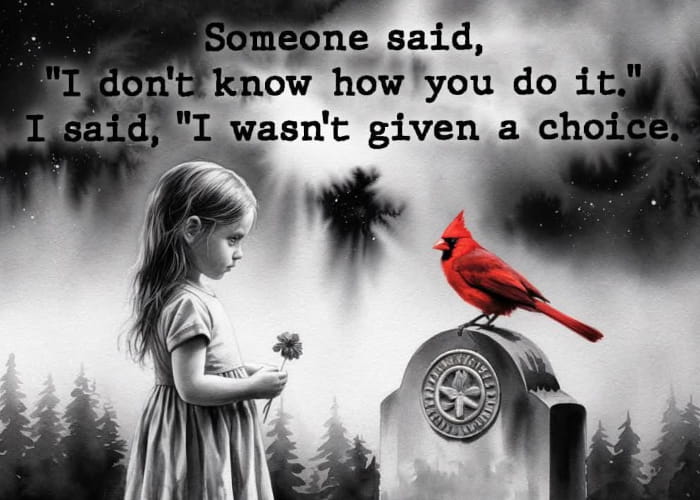

Losing your parent is a wound that never truly closes, no matter your age. They are the ones who gave you life, who shaped you from the very first heartbeat. Their presence is woven into your DNA, their love carved into your soul. The bond between parent and child is more than biological—it is primal, sacred, and essential. As infants, we desperately relied on them to survive. Our parents were our protectors, our haven in a bewildering universe, standing between us and every threat until we could learn to stand on our own.
But what happens when a father or mother dies when you are only three months old, or five years of age, or thirteen? You do not just lose a parent. You lose the guiding star that was supposed to see you through the storms of childhood, the steady hand meant to lead you toward adulthood. The world suddenly becomes a dangerous, cold, unfamiliar place where safety and comfort dissolve overnight. Death is not just a distant shadow; it becomes a wall that slams into you before you have even learned to run and before life has revealed its miracles. You are forced to wander through a world stripped of the loving guidance, protection, and security so vital to growing into a healthy adult—left to piece together hope, dreams, and identity from the fragments of what should have been.
Death arrested our healthy development, and grief has turned into a lifetime of longing. The absence of a parent is a daily ache, a silent grief that stretches across all the milestones: graduating, stepping onto a college campus, walking down the aisle, welcoming your own children, facing heartbreak and triumph. Their absence is a shadow that follows us through every major event of our lives, a constant reminder of what was stolen, the celebrations that will always be marked by a missing face in the crowd.
Our grief is not fleeting, it is a lifelong companion, as constant as our heartbeat, growing up alongside us and lingering until our final days. For those who lost a loved one too soon, grief becomes a silent shadow, creeping into every corner of our lives. It is the only way our love for our dead parents continues to exist. Prolonged grief shapes us—complex, terrifying, brutal, silent, hidden from view. It evolves as we grow, often buried deep beneath the surface because facing its magnitude was too much. Like a dormant volcano, it erupts when our strength finally runs dry, when our bodies can no longer contain the pain. And as we gain the capacity to sit with loss, it does not become easier. In fact, the pain can intensify, growing sharper after years of silent suppression.
Losing a parent at an early age does not make us stronger; it simply forces us to endure what should never have been asked of us. Accepting life without our parent comes at a brutal cost—loneliness, PTSD, waves of depression and anxiety, struggles in forming healthy relationships. Yes, we barely made it into adulthood, but the price was a toll that no child should ever be required to pay. The tragedy is not just in the loss, but in the lifelong echo of that absence—and in the heartache that we carry, always.
Can you recall people feeling pity for you? Share your story in the comments!
2 Comments
Beautifully written. We were so young and so unprepared. Death shouldn’t have been anywhere near our radar, but we were forced to become familiar with something so final. I don’t recall the reactions of others. I think most of the outward attention was on my mum, but I’m sure people did feel for us. They perhaps just didnt know what to do or say so hoped we’d get over it. As you say, though, this is a grief that never leaves you( and never, I think, really diminishes) Kirsten x
I had a similar experience, Kirsten. The attention was on my grieving mom. I do think that adults might have a hard time addressing a child’s way of grieving. “What are the right words to say?”, is what probably is on their minds. And yes, it is a grief that never leaves us because our loss single-handedly changed the trajectory of our lives.